Tuesday, October 5, 2010

Mr K Ravi

Mr Ravi, a former teacher of Catholic High who taught Lee Hsien Loong (Pre-U 2, 1969) paid respect to Mrs Lee Kuan Yew (Madam Kwa Geok Choo) who passed peacefully at home at 5.40 pm on 3 Oct 2010. Mrs Lee Kuan Yew was mother of Prime Minister Lee Hsien Loong.

Mr Ravi has now retired from teaching and is 76 years old.

Sunday, September 5, 2010

Interview: Lim Kia Hong 林嘉丰

The Sunday Times carried a story of Lim Kia Hong (Catholic High, Sec 4 1973)  on 5 Sept 2010. Here is the report:

Love has lots to do with Mr Lim Kia Hong's success as the largest distributor of computer systems, software, peripherals and networking products in South-east Asia and Hong Kong.
His love of new shiny gadgets and tech products led him to set up an IT distribution firm 27 years ago.
Because he loves thinking of fresh marketing ideas to introduce new gadgets to people, he would still do the same thing all over again if given another chance as a young man.
'I'm a man with a lot of love and passion. You need to love and be passionate about what you do in life. Otherwise, it's difficult to continue to do a good job,' said Mr Lim, 57, in his office in Leng Kee Road.
Because of this love, he does not mind if his entire waking moments are taken up thinking about tech marketing.
'I've notepads everywhere, next to the TV, in the drawer and shower. When I get ideas, I jot them down. Otherwise, I may forget them,' he said.
Mr Lim's love affair with tech began at the University of Washington, Seattle, which he joined in 1979 after his A levels at Hwa Chong Junior College. He was enrolled in the university's School of Business and Accounting, but he found he did not like accounting, and instead opted for marketing and information systems.
On completion of his course, he returned to Singapore in 1982 to finish the remaining six months of his national service.
'I was a naval project officer but since I'd studied information systems, I was one of a few people familiar with computers in 1982. So I was posted to Mindef (Ministry of Defence) headquarters to be part of the ministry's computerisation project,' said the soft-spoken Mr Lim.
He found there were many things like diskettes, cables and software that he needed but were not available in Singapore. He began buying them from the United States for Mindef.
Soon he was hooked on this process of looking for new things to buy. He decided to start a company. But his first venture with a friend went south in less than a year because while he was interested in microcomputers, his friend was focused on bigger office machines called minicomputers.
He then convinced his brother- in-law, Mr Lim Hwee Hai, to go into business with him to start SiS (Scentek Information Systems) Technologies in 1983.
The company began with a $100,000 investment from Mr Lim's father who was in the commodity and manufacturing business. The money went into paying for the goods they bought from the US. The office was shared with his father's company.
'We shared his office in Boat Quay. He had his table on one side. By the time, I put in our table and two chairs, it was a tight squeeze. HH (Hwee Hai) and I had to climb over the table to get to our chairs.
'My father bought us two Chinese chairs which were a little lower than the normal office chairs which let us squeeze into them,' he said. He still has the two chairs in his office.
The early years were tough. Customer visits turned out to be educational talks because he ended up teaching them about what a computer was, what a CPU (central processing unit, which is the computer's brain) was and what word processing was.
He made sales calls during the day. At night, he cleared paperwork. He logged 18- to 20-hour work days and learnt to make do with four hours of sleep each night.
His father worried about him because he did not see him at night or in the morning. In an attempt to stay at home more often, the young Mr Lim installed the office telex machine in his bedroom. Phone calls to the US were costly at US$30 a minute then. Sending a telex was cheaper. Trouble was, the click-clack of messages as they came in ruined his sleep. A week later, the telex machine was back in the office.
But his bedroom became a storeroom, filled with diskettes and printer ribbons. Since his room was air-conditioned, it prevented the ink from drying up and the diskettes from getting mouldy.
In the first year, Mr Lim rang in $150,000 in revenue. The company was profitable and they had five employees. The initial list of products soon expanded to include software for networking and e-mail, productivity and security programs, wireless equipment and, more recently, smartphones.
'We brought many US companies to Asia such as 3Com, a networking company. We were its longest distributor until it was acquired by Hewlett-Packard last year.
'I brought in all the e-mail software like ccmail and Novell mail. I also introduced Aldus PageMaker and other companies like Symantec and Trend Micro to the Asian market.
'At one time, we had products competing against Microsoft until we became their distributor in 1995. Now we're Microsoft's top distributor and we work very strategically to launch new products,' said Mr Lim.
Even before the Government's encouragement to regionalise, SiS had opened offices in Hong Kong because Singapore was just too small a market. Today, SiS is headquartered in Hong Kong, where it was listed in 1992.
It was also listed on the Stock Exchange of Thailand in 2004. Its group revenue last year was US$1 billion (S$1.4 billion).
SiS has a network of 10,000 retailers throughout South-east Asia and Hong Kong. It represents an A-list of companies including Hewlett-Packard, Adobe, D-Link, Asus, Apple, Canon and HTC.
It has no plans at the moment to go into the two giant growth economies, China and India.
'I can take the risk and just open offices there. But my gut feel is that China and India are not ready for distribution. SiS would need deep pockets to penetrate such big markets,' said Mr Lim.
He attributed his success to his staff, some of whom have been working with him for about 20 years.
'In every country, we've about 10 to 15 people who are key to our business, but they are not in heavyweight positions. For example, in the distribution business, you've to be in delivery and warehouse. So the delivery guy and storekeeper are key to the business. Without them, my goods may not be delivered and my stocks unaccounted for,' he said.
He and these people have struck a close relationship over the years, socialising over dinners. He knows their families 'and we share our experiences of kids growing up'. He is married with four children - two sons and two daughters.
Because of China's rise as an economic power, he is persuading his elder son to consider attending a Chinese university and his elder daughter to take higher-level Chinese in secondary school. He himself is effectively bilingual. His alma mater is Catholic High School.
With nearly three decades of doing business, he believes that entrepreneurs must always 'be prepared and never say die'.
'This is about failure. I learnt from my school basketball coach who said that every time the team played a match, he wouldn't know if it would lose or win. But the team must be prepared. If we lost, then we'd pick ourselves up, learn what went wrong and think about ways of winning the next match.'
The other lesson is to try new ideas. SiS, he said, was the first to do taxi-top advertising when then NTUC Taxi launched this new advertising concept in the mid-1990s.
Breaking new ground in marketing strategies is 'like falling in love with a woman when every waking moment is spent trying to please her', he said.
Another tip for wannabe entrepreneurs, he said, is to learn to love the competition. 'Good competition keeps me on my toes, raises my standards. Lousy competitors, I don't like.'
Ideas come from his dreaming, which he admits is his full-time job, leaving the day-to-day operations to his brother-in-law.
'I dream about my love: the new technologies, how to market them. I dream about new corporate strategies and how to overtake my competition. That's why I don't dream at night. I've a nice job which hasn't changed since day one and which I love.'

Wednesday, August 11, 2010

Lim Kia Hong 林嘉丰

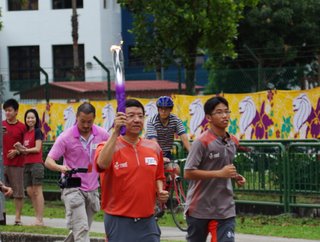
One of our old boys, Lim Kia-Hong (Sec 4, 1973), is among the 2,400 specially-selected Torch Bearers for the First Youth Olympic Games (YOG) being hosted here in Singapore. The YOG will take place from 13 August to 26-August-2010. Kia-Hong participated as a relay-runner last Saturday, 7-August, in the Ang Mo Kio vicinity. The relay will cover a distance of 305 kilometers – equivalent to travelling the entire length of the island six times.

Lim Kia Hong is Chairman and CEO of SiS International Holdings Ltd.

Founded in 1983, SiS is one of the largest distributors of computer systems, software, peripherals and networking products in Asia.

Headquartered in Hong Kong, with regional offices in Singapore, Malaysia and Thailand, SiS offers manufacturers an immediate access into Asia with a well established network consisting of more than 10,000 resellers, retailers, system integrators, software houses, value added resellers and OEMs strategically located throughout the region.

SiS represents and has earned its reputation as the Preferred Distributor by a number of the world's most renowned manufacturers including Acer, Adobe, Apple, Asus, AutoDesk, BenQ, Canon, Cisco, Computer Associates, EMC, Emerson, Epson, Fortinet, Fuji Xerox, H3C, Hewlett Packard, HTC, IBM, IBM Software, Infocus, Lenovo, Linksys, Microsoft, Novell, Symantec, Veritas, VMWare, WatchGuard, Western Digital.

SiS is a public listed company on the Hong Kong Stock Exchange.
Old boy (Lee Hsien Loong) meets old boy (Lim Kia Hong).

Sunday, August 8, 2010

Joshua Goh 吴钧龙

A Catholic High old boy Jushua Goh is one of five recipients of the Singapore Armed Forces Overseas Scholarship 2010. Joshua Goh is also one of five President's Scholars in 2010.

OCT Joshua Goh (Catholic High Sec 4/2007) will read Chemistry at the Imperial College in London. Joshua is at the centre in the picture below.

Joshua is also the son of our old boy Goh Eng Ghee (Sec 4/1971). Goh Eng Ghee is currently the Deputy Chief Executive of the Singapore Workforce Development Agency.

The four other Armed Forces Overseas Scholarship recipients, also 19, are bound for British universities. They are:
  1. Catholic Junior College alumnus OCT Joshua Goh, who will read chemistry at Imperial College in London;
  2. Midshipman Soh Kah Lake, formerly of Hwa Chong Institution, who will take up chemical engineering at University College London (UCL);
  3. His fellow Hwa Chong alumnus OCT Tay Jian Hua, who will study economics at UCL; and
  4. RI (Junior College) alumnus OCT Seth Jun Hao, who will read aeronautics at Imperial College.

Saturday, July 10, 2010

马炎庆 Baey Yam Keng

马炎庆, 1987年公教中四毕业。
以下是联合早报的报道。

“海燕等人” 新戏 《内衣阁》 打开“内衣阁” 触碰敏感地带
(2010-07-08)

联合早报● 周文龙
 
国会议员马炎庆和太太林海燕呈献的限制级舞台剧《内衣阁》,内容和台词非常大胆,但林海燕却不担心会引起审查问题。她说:“批评政府并非错事,最重要的是不应一味批评,还需有艺术良知。”

马炎庆则说:“《内衣阁》可能涉及一些敏感地带,但我相信我们有足够的社会空间。”
本地议员马炎庆和太太林海燕呈献限制级舞台剧《内衣阁》,请来MM、SM和PM,一起在台上大谈内衣论?

哈,原来这些名称指的并非我们的内阁部长,而是剧团里的职位。
由 “海燕等人”剧团呈献的新戏《内衣阁》,有着MM、SM和PM等角色名称,令人联想到我们的内阁资政(MM)、国务资政(SM),以及总理(PM)。

但《内衣阁》编导林海燕说,这些名称只是跟观众玩文字游戏,博得观众会心一笑,并非直接针对任何一位内阁部长。
事实上,所谓的MM、 SM和PM,指的即是剧场最重要的三个职位:行销经理(marketing manager)、舞台监督(stage manager),以及制作经理(production manager)。

林海燕说:“约3年前,我无意中发现我们剧场的几个重要职位,简称竟然跟我们的内阁部长一样,这个巧合性让我觉得有趣,也让我联想到我们的剧场环境,或许跟我们的政治环境非常相似,我可以借用剧场环境去看一个更大的政治空间,表达各种政治隐喻和联想。”
有趣的是,林海燕的丈夫马炎庆,是《内衣阁》的监制,同时也是丹戎巴葛集选区议员。

Wednesday, May 12, 2010

Quek Ser Aik 郭斯奕

Quek Ser Aik is an old boy of Catholic High (Sec 4, 1969). Here is a report in the Straits Times.

May 10, 2010
Going to Gobi
By Nicholas Yong

ASSOCIATE Professor Quek Ser Aik is heading to the Mo-Kia-Yen Gobi Desert for a third time for the annual Gobi Desert Business School Challenge next week.

At 56, he is the oldest member of the 10-man team from the National University of Singapore (NUS) Business School, which will be taking part in the 110km trek across the desert for the fourth time since the event started five years ago.

He says: 'It is a strange feeling to be walking 'alone' in the desert. It is so big and dangerous, and there is a very real sense that you are the only person around for a few kilometres.'

The 110km endurance challenge re-traces the journey of the Tang dynasty monk Xuanzang, or Tripitaka, on his journey to the West along the Silk Road almost 1,500 years ago. It is organised for networking purposes.
From May 16 to 19, nearly 240 people from 12 business schools in China, Hong Kong, Taiwan and Singapore will cross the desert on the borders between Gansu and Xinjiang provinces in China.

The NUS team comprises six men and four women, including staff and students. Among them are permanent residents, Chinese nationals and a German student. Last year, NUS finished last out of 10 teams.

Assistant Professor Song Zhaoli, 39, second-time participant and team leader this year, says it was because they did very little training this year. Subsequently, five members got injurede on the first day and struggle to carry on. They were also unfamiliar with their GPS equipment and were hampered by poor quality equipment - their water bags leaked, leaving them dangerously short of water.

Prof Quek adds: 'To be short of water in the desert is no joke. SOme team members almost got heatstroke. One female student was even hallucineting.'

Nevertheless, everyone perservered till end in four days.

This year, the team will be better prepared. On top of individual training, they have been doing thrice-weekly 7km treks with 5kg backpacks as a team and recently did a 28 km trek at MacRitchie Reservoir. They plan a 40km trek before setting off.

Professor Teo Chung Piaw, 44, acting deputy dean of the Business School, is going on trek for the first time. 'I have been started walking the 8km from home to my office, which I never thought I would do before.' he says.

Prf Quek adds, 'This year, we are prepared because of Professor Song. He insisted that we do our preparation. In previous years, we hardly trained. Last year, I basically just showed up.'

The beauty of the environment is why Prof Quek is going for the third time. He says: 'At the end of the trek, it is so exhausting that you just remember the romantic parts. When you are walking, your mind is clear and it's very good time for reflection about work and family and different thimgs. Some people do it by the poolside, I do it in the Gobi Desert. You also remember the camaraderie, just like in the armi.'

Tuesday, April 27, 2010

张东孝 Daniel Teo Tong How: 变公教旧校舍为艺术中心 张东孝砸250万回母校听钟声

Daniel Teo studied at Catholic High from 1956 (Jr Middle 1) to 1961 (Sr Middle 3). Below is a report by Zaobao today:

  公教校友、煌孝集团主席张东孝对母校感情深厚,他事业成功后不忘回馈母校,去年和好友一起标下由两栋建筑组成的公教中学旧校舍,虽然租期只有九年,却不惜投下250万元改建成综合艺术中心“222 Queen Street”。当他再次听到校舍隔邻教堂传来的嘹亮钟声,觉得就是那少年时代熟悉的钟声召唤他回到母校。
很难想象,当年在旧公教中学课室默默上课的少年人,有一天会成为新加坡的著名房地产发展商。更值得一提的是,他要让自己的母校旧貌换新颜,在新时代里,为它找到新的使命,使它在几个月后,成为一个具特色的多元综合文化艺术中心,同时不忘保留母校的历史和文物,在建筑中设立校友厅,也拟议兴建一个公教博物馆。
■ 悠扬的钟声唤醒回忆
  这名公教的优秀校友,就是67岁的煌孝集团(Daniel Teo & Associates)主席张东孝。他的夫人是新加坡著名芭蕾舞蹈家吴素琴。张东孝本身曾留学澳洲学建筑,对于音乐、舞蹈、美术、集邮等都有浓厚的兴趣。
  访问当天中午,窗外忽然传来隔邻教堂的嘹亮钟声,他感触良深地说:“这是我最熟悉的声音”。也许就是这阵阵悠扬的钟声,一再唤醒这位老校友在公教六年学习生活的回忆,使他毅然砸下250万元的重资,为一座废弃了20年的旧四层校舍,注入新的生命和活力。他说:“刚搬进来时,发现这里的情况非常糟糕,厕所卫生条件差外,电线很多被人偷窃。本来学校是和教堂相连的,后来已被一道灰色围墙所分隔。”
■ 为文化区增添光彩
  在回忆校园生活时,张东孝说:“当年有很多儿童修士,给我留下深刻印象,他们一律剪光头,非常可爱。不得不提的是创校校长、法国籍的劳爱华神父,后来的张世典修士和宋宝书修士,后者到马来西亚创立吉隆坡的公教中学时,我们还经常有联络。”

  张东孝一度是公教校友会董事。对于自己目前的一系列努力,他说是在回馈母校和社会。
  旧公教中学位于奎因街和滑铁卢街之间,校舍在原址已经矗立了75年。张东孝说,集团去年和另一名志同道合的好友刘先生(Andrew Lau)成功标到这个由前后两栋建筑组成的旧校舍,并把它取名为“222 Queen Street”。目前整个维修工作还在紧锣密鼓进行中,预计工程将分段在四至六个月内完成,可以预知的是,到时将为这个新加坡最有文化、艺术环境和气氛的地区,增添异样的光彩。

  近几年来,在多方面合作下,本地有不少旧建筑改为艺术场所,其中如附属于新加坡美术馆的“8Q当代美术馆”,前身是公教附小。而位于爱美丽山的Old School展馆,曾是美以美女中的旧校舍。空置多年的Alkaff公寓,未来也会改建为综合性画廊、博物馆和餐馆的休闲去处。


  当局认为:拥有丰富历史的建筑物大多位于黄金宝地,具有人潮众多,交通方便,靠近市区的优点,这可帮助发展商和经营者节省重建的庞大费用。
■ 希望公教校友捐献文物

  重要的是,正如张东孝所说:“这些旧建筑都富有历史和艺术观赏价值,虽然目前新加坡只有百余间保留性建筑,我们这次的租用期也只有短短九年,在翻新时,还是要照顾到保留建筑和历史古迹的条件要求。”
  那么,旧公教中学又会留下什么珍贵文物和遗迹?

  他说:“我非常希望能发动校友有钱出钱有力出力,尤其捐献一些珍贵纪念品给公教博物馆。目前找到一个杯子,是李资政夫人当年把两位公子李显龙总理和李显扬送到公教读书时的家长纪念物。公教校友广泛分布于社会的各个领域,相信他们手头,一定有许多宝贵的公教文物。”
  另外,维修后的综合文化艺术中心,除了保留原有的楼梯、木门、壁画,墙上的校徽,黑体的书法校名也重新粉刷,上色,公教校友熟悉的四楼礼堂中的学生画作,也是重点保留项目之一。”
80%空间作艺术用途
  张东孝谈到综合文化艺术中心的具体用途和规划时说,整个四层楼的可用面积是6000平方公尺,在维修完成后,其中80%将作为艺术、文化用途。

  基本规划是:注重新的概念和传统的保留。目前使用的是二楼和四楼的空间,出租率高达70%。 


  ●一楼:

  全部冷气的一楼,将作为餐饮用途。但经营上不走高格调路线,服务对象是一般公众人士,定位在提供快餐,让上门的顾客至少有五六种口味选择。
  ●二楼:
  艺术与画廊将是主打。目前已成功吸引到一家德国画廊Art Trove前来。
  这里也是张东孝展示私人收藏品的美术馆。有好些绘画作品,是当年他在金炎路与一名瑞典画商共同开办画廊时的收藏。
  目前在二楼展出的,是公教前美术老师冯所尧的“创意美学系列”水墨画。
  ●三楼:
  这里将是3D电影院所在地,也是音乐学院、摄影艺术工作室和乐活健身室。同时是一间大型校友厅,以后供校友活动的地点。
  ●四楼:

  四楼将为公教校友带来最多温馨回忆。这里是目前的小型校友厅和未来的公教博物馆所在地,过去则是学校礼堂。


  之所以利用这个空间,是因为它的屋顶够高,空间也够大。校友们将可回来观赏当年他们在这里的墙上留下的众多画作。
  四楼也是“新加坡芭蕾舞蹈学院”的新址。过去该学院一直在福康宁山的艺术中心活动,目前共有学生500多名。

Monday, April 5, 2010

吴韦材写黄伟光老师 Ng Wai Choy

吴韦材,公教校友,全职作家,以小说、散文、杂文、诗、游记等文体发表过不少作品,其中尤以游记风靡不少读者,并掀起一阵年轻人的自助旅游热。

1983年,他与一位摄影同伴做长途自助式旅行,并在《联合晚报》发表游记,一共持续三年。1987年开始在《联合早报》发表游记,称为《背包走天涯》。其他著作有《吴韦材怪谈》、《解连环》、《泥土手记》、《九个半女人》,其中《泥土手记》获得1991年度散文组全国书籍奖。

1997年离开南极后,他到中国北京电影学院电影导演系学习1999年底回国。现在专注于舞台剧演出项目,最新剧作为《友善角落》、《生命中难以承受的猪》(我爱猪猪),最新著作为《吴韦材异境奇幻》及《吴韦材错体古典》。 2000年,他在互联网上设制一个属于自己的网页,称为摇摇网(yoyonet.com)。内容丰富,画面精美。网页内容共分成十大栏目,即《情爱生活》、《饮食男女》、《精品文化》、《美丽世界》、《新元素时代》、《家居空间》、《健身所知》、《网友优 待》,而《车迷乐园》及《近期推出》还在筹备中。在这些栏目中,又分成许多小栏目,如在《文化精品》中,又包括了《激情感官》、《收藏家与艺术鉴赏》、《雅俗共赏》、《电影弹赞区》、《接触吴韦材》、《娱乐前线》、《传统戏曲荟萃苑》,让网友能在这里接触到艺术工作者、作家、名人、主持和学者,互相交流人生品味与心得。

今年三月,校友会组织了三峡游,这是他四月5日在联合早报发表的有关文章。文章里特别提到了今年八十多岁的黄伟光老师。

‘  校友会组织三峡游览团,80余名不同年代的校友一齐畅游。更教人值得高兴是,我还看到张校长和两位教过我的老师。校长与老师,年纪也都确实老大了,但他们精神状态都很好,更幸运是一路上只要有机会,我都能跟随在长者身边,尤其黄老师,那头偶尔飘飘然、积累着人生丰富智慧般的白发,还有慈祥可亲的言语,有时甚至还来点幽默,让我这趟旅途倍感温馨难忘。
其实是,我自己年纪也不小了。我想假如不是现在的我而是20年前的我,相信这份感触还不至于如此强烈。可现在我也是个老师了,有些心情,现在的我就如有了默契般,也明白了多一些。
我相信黄老师也有过他自己的老师。就如同在我生命里曾经有他出现的这一段时光。或许以前,日子匆忙的我没时间去细细回顾这些过往,但如今老来我就明白了,人的一生形状,更多时候是在不断的回顾里塑模成型的。
这就像,我最初写游记时总喜欢原汁原味的现场感,写到后期我才发现,一座山一片海一个城市所能给我最确切的体会,其实是过后重新在自己思维里将它们再次塑模起来的时候。就因有所沉淀,所以倍感清晰,就如那座山那片海那个城市,真正烙上自己的体会,那才是真正到过的。这也就如一个人,一段过往,或是人生的某个阶段,也因为凝合上自己不断反复的回顾,它们才越加真实地牢固起来——除非我刻意铲掉自己少年时代让它随风而逝,但假如无论那时代是甘甜是苦涩我都认为是自己一生里无法分割的部分,那么我更愿意使它们坚固起来,那就是我,而我要完整的一生。
旅途上有位92年毕业的小学弟很天真地问我,当然,问这问题时他只是一片坦然的直觉,他问:“你们每次聚会无论多人少人都是这样一齐唱校歌的么?”我说,“对啊。”他问, “不会觉得怪怪么?”我笑笑说,“不会啊。”看他神情还是不甚明白,我就安慰他,“你现在还小,等你年纪再老大一些,等你一天感到有些自己青春年少的记忆渐渐被磨得模糊时,你就会大大声一齐跟着唱了。”我都还没告诉他,唱校歌有时唱到感觉涌来之际,好像唱完就可以坐下来上课,感觉空中就像有个熟悉瞬间,虽闪电而过,却那就是真实。
旅途上,黄老师的手常扣在我臂弯里,下梯级时,他会稍稍用力,黄老师是我们训育主任,他教学风格还是挺严厉的,除教授课文,黄老师更多时间是教我们这班猢狲如何好好做人,当年年少的我,并没强烈感觉到这一课人生启蒙是紧紧地扣在他的指引上,如今在我臂弯里,在这绵延不断的山峦和这源远流长的江河间,我真真切切地感觉到这指引过我的手,除了人与人的信任与温暖,也确切地感到在一个老师与一个学生之间,其实就是一份深深凝成的情谊。
快半世纪了。半个世纪前这些师长掀开我们人生道途的启蒙,半个世纪后今天,我们还能携手并行于山水间的美好人世,一分,一秒,都是珍惜。’

Saturday, March 20, 2010

巫顺昌 Moo Soon Chong

巫顺昌于1964年毕业于公教高中二。他于2010年3月16日逝世,享年63岁。生前是新加坡体育学校的首任校长。以下是联合早报3月19日报道李显龙总理(也是公教校友)对巫顺昌的评价。

我国需要更多像巫顺昌这样热心献身栽培新一代,而且又能成为莘莘学子楷模的教育家。  
- 李显龙总理

李显龙总理称赞已故的体育学校创校校长巫顺昌,是一位脚踏实地、献身服务的教育家。

他昨天在致给巫顺昌夫人黄瑞娥博士的唁文中,赞赏巫顺昌对华文教学的热忱。在1998年担任学校华文教学委员会委员时,就客观地理解了双语教育政策在日渐普遍讲英语环境中的挑战,协助委员会拟定好一些改善华文教学的建议,包括创设供华文程度较弱学生选修的“华文B”课程,以及建议南华中学成为第10所特选中学。

李总理也表扬巫顺昌协助创建新加坡体育学校,以及在担任该校第一任校长时所制订的正确办学方针。

他说,我国需要更多像巫顺昌这样热心献身栽培新一代,而且又能成为莘莘学子楷模的教育家。


李总理致给黄瑞娥博士唁文

敬爱的巫夫人,

巫顺昌先生逝世噩耗传来,我深感难过。

巫先生在教学专业服务了36年之久,不愧是一位资深教育家。他热爱体育,待师生谦逊随和,执教不倦。人们将永远怀念他。

初识巫先生是在1998年,那年他在我设立的学校华文教学委员会中担任委员。当时,他是圣公会中学的校长。我发觉他是一位献身服务而且脚踏实地的人。他客观理解我们双语教育政策在日渐普遍讲英语环境中的挑战,对华文教学充满热忱。他深知学生在学校该学习什么以及该采取哪一类措施协助学生更好地掌握华文。他的丰富经验和见解,协助委员会拟定出好些建议,包括创设供华文程度较弱学生选修“华文B”课程,以及建议南华中学成为第10所特选中学。

2002年,巫先生协助构想和策划我们全新的新加坡体育学校,并成为这个两年后开课的学校的校长。教育部和社会发展、青年及体育部特地邀请他担当这个重任,就是为了确保体校能够成功而且顺利开办。他在体校从无到有的建设过程中以及为该校制订正确办学方针方面,起着举足轻重的作用。2004年,我在巫先生的引领下参观了体校。他对体校引以为豪,无庸置疑的全体教职员和学生在他英明领导下也深深受到激励。这可从该校做到体育训练与学术教导方面保持平衡的情况,以及栽培出多名杰出运动员的事实中显现出来。

我国需要更多像巫先生这样热心献身栽培新一代而且又能成为莘莘学子楷模的教育家。

谨此致悼


李显龙

Thursday, March 11, 2010

Tan Chin Tiong 陈振忠

Old boy Tan Chin Tiong, who is the President of the Singapore Institute of Technology was in new recently, as reported by Today newspaper on 10 Mar 2010:

Although it is not officially the Republic's fifth university, Singapore Institute of Technology (SIT) president Professor Tan Chin Tiong seems certain on the direction his six-month old organisation should take.

In an interview with MediaCorp, Prof Tan said that among SIT's long-term plans is "that we will evolve into a university".

"It will take a while (so) for a start, we will leverage on the foreign universities first ... When we have the capacity, our end point is that we want to offer dual degrees together with the foreign universities," said the 61-year-old, who is also one of the founding academic members of the Singapore Management University (SMU).

"But along the way, we will tweak the equations and get more dimensions to the template."

Things can be said to have progressed quickly since Prof Tan took the helm of the institute, which was formed last year to provide another route for polytechnic students to upgrade and obtain industry-relevant degrees.

Although these programmes were originally slated to start in 2011, SIT and the polytechnics here will launch its first programme for eight degrees in partnership with five overseas universities from August.

According to Prof Tan, SIT is able to start a year ahead of schedule as it has been able to tap on the strong relationships that the Ministry of Education and other ministries and agencies, such as the Economic Development Board, have with overseas educational institutions.

Schools partnering with SIT include Germany's University of Technology, Munich, for electrical engineering and information technology; and the United Kingdom's Newcastle University for naval architecture, offshore and marine engineering.

The DigiPen Institute of Technology and the University of Nevada, Las Vegas - both from the United States - will also team up with SIT to offer degrees in animation and game design and hotel administration, respectively.

Finally, the Culinary Institute of America will also offer a degree programme, although details are not available as yet.

Said Prof Tan: "The five overseas universities that we are partnering in our first wave of degree programmes have a presence in Singapore and are already offering their programmes here or have been receiving polytechnic graduates in their home campuses".

Not only are these partners familiar with the Singapore education system, they also "have confidence that it produces high quality polytechnic graduates who are able to articulate into their programmes", he added.

Education Minister Dr Ng Eng Hen told Parliament yesterday that not only will SIT's unique model bring together these renowned institutions here but "these leading partners will add value and recognition to our polytechnic diplomas as they provide advance standing".

Graduates will also be able to obtain to obtain degrees after two years instead of three to four, said Dr Ng, who is also the Second Minister for Defence.

The participating institutions have been chosen not only because they are leaders in their respective disciplines but also because SIT "wants to create degree opportunities not offered by the other schools. We play a role in offering diversity in the education space", said Prof Tan.

Ngee Ann Polytechnic's director of planning and projects office, Mr Peter Lam, described the new courses offered by SIT as "both affordable and very attractive".

Prof Tan said the challenge is to let polytechnic graduates know that "their route to the universities does not lie only with the National University of Singapore, the Nanyang Technological University or the Singapore Management University". (The fourth university - the Singapore University of Technology and Design - will be ready in 2011.)

Prince Peter Jacob, a 25-year-old who is pursuing a naval architecture degree at Newcastle University, said: "There is a high demand for qualified engineers, especially in the marine industry."